

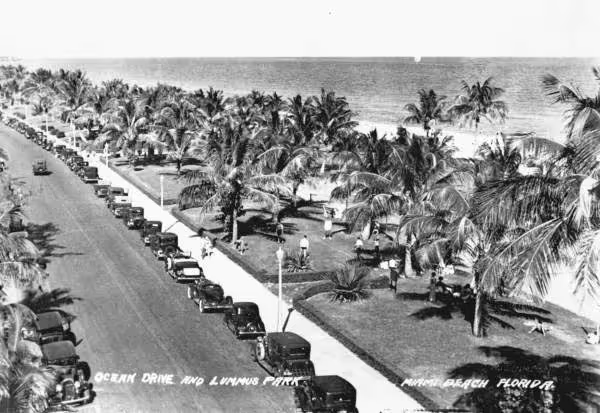
Miami Beach’s history is a story of bold ideas and constant reinvention. What began as a remote barrier island of mangroves and sand grew into a world-famous city shaped by developers, designers, artists, immigrants, and natural forces. This timeline explores how Miami Beach evolved decade by decade, revealing the people and moments that turned an unlikely landscape into the place we know today.
In the 1870s, Miami Beach was an undeveloped barrier island dominated by mangroves, sandbars, and shallow freshwater pockets. Access was only by boat, and the idea of a resort city here would have sounded wildly optimistic.
That optimism belonged to brothers Henry and Charles Lum, who purchased 165 acres on South Beach in 1870 for just 75 cents an acre. Their plan was to grow and harvest coconuts for commercial use, an early example of the agricultural experiments that defined the island’s first chapter.
In 1886, Charles Lum built the first permanent home on Miami Beach near the present-day site of the Tides Hotel. It stood alone in near-total isolation, surrounded wilderness.
By 1894, the coconut venture had failed. The Lums abandoned the island, leaving their land in the care of John S. Collins, a New Jersey farmer whose patience and curiosity would reshape Miami Beach’s future.
The early 1900s marked the moment Miami Beach shifted from experiment to possibility. In 1903, the Army Corps of Engineers dredged Government Cut, creating a permanent channel to the Atlantic Ocean and establishing Miami as a viable port city.
In 1907, Collins expanded his landholdings north to what is now 67th Street. His discovery of freshwater indicators allowed him to successfully grow avocados and vegetables, proving the island could support permanent settlement.
The decade closed with infrastructure beginning to catch up to ambition, setting the stage for Miami Beach’s explosive growth.
The 1910s were defined by visionaries. In 1912, the Lummus Brothers purchased 400 acres south of Collins’ land and founded the Ocean Beach Realty Company, envisioning a modest oceanfront residential city.
Everything accelerated in 1913 with the arrival of Carl G. Fisher, who believed Miami Beach should be a destination unto itself. Fisher acquired land between 14th and 19th Streets and helped finance the Collins Bridge, then the longest wooden wagon bridge in the world.
That same year, Joe’s Stone Crab quietly opened its doors.
On March 26, 1915, Collins, Lummus, and Fisher incorporated the Town of Miami Beach. J.N. Lummus became its first mayor, and land from 6th to 14th Streets was dedicated as Lummus Park, preserving public beach access forever.
By 1918, the MacArthur Causeway permanently linked Miami Beach to the mainland, sealing its future as a city.
The 1920s transformed Miami Beach into a national sensation. The land boom attracted millionaires like Harvey Firestone, J.C. Penney, and Rockwell LaGorce, who built estates along Millionaire’s Row.
Carl Fisher fueled the glamour with the Flamingo Hotel, Roman Pools, Casino, and trolley system. Star Island was dredged, golf courses opened, and automobile-friendly streets reshaped the city.
The boom collapsed after the devastating 1926 hurricane, which flooded the island and caused extensive damage. Still, Miami Beach endured, acquiring Flamingo Park in 1929 and preparing for reinvention.
The 1930s ushered in Miami Beach’s iconic Art Deco era, producing the architectural style that defines South Beach today.
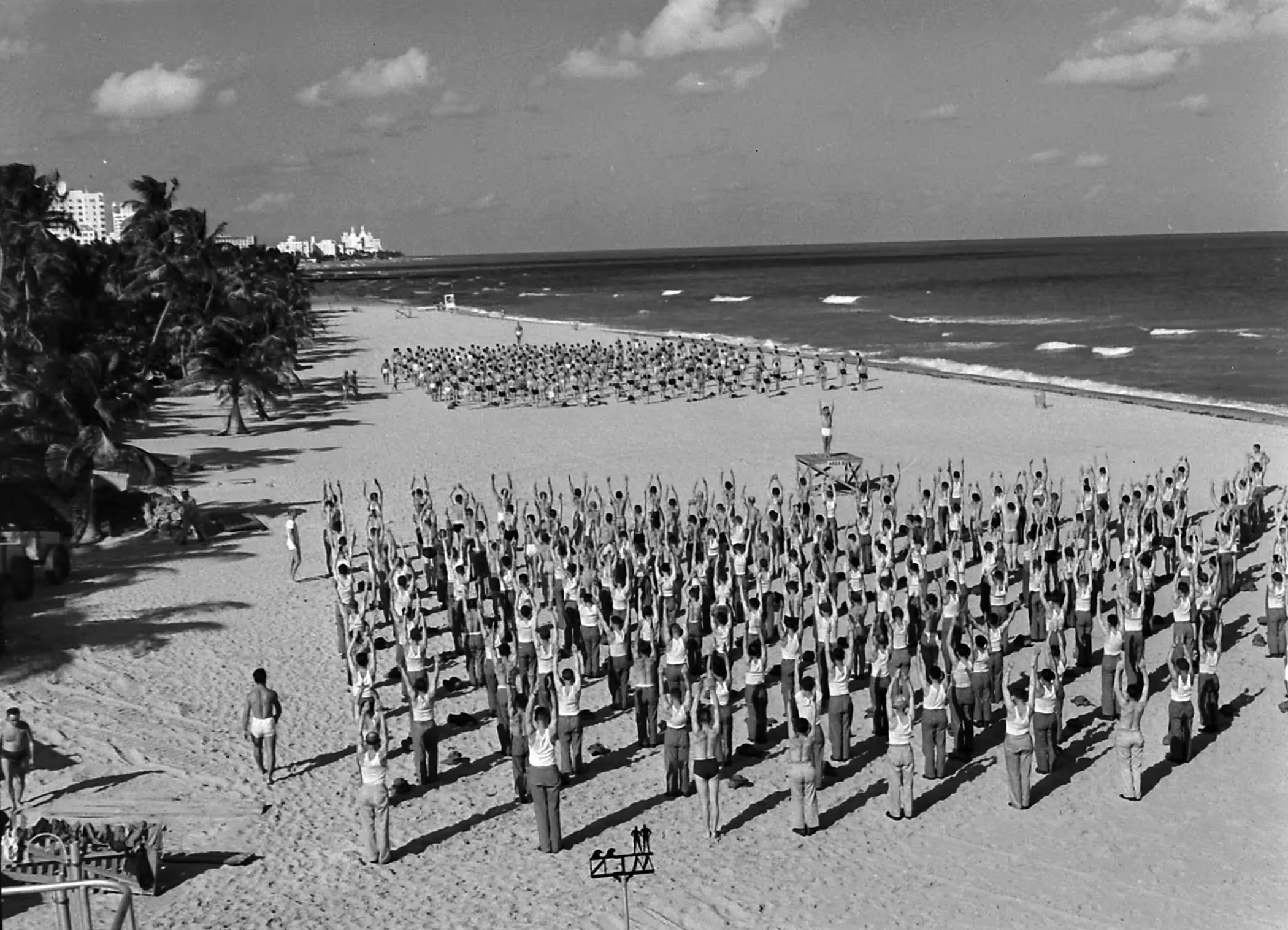
By 1941, World War II changed everything. Following Pearl Harbor, the U.S. Army Air Corps took control of many beachfront hotels, converting them into training facilities and filling the city with servicemen.
After the war, Miami Beach reemerged as a glamorous resort destination.
The 1950s brought mid-century optimism and architectural boldness. Morris Lapidus redefined luxury hospitality with the opening of the Fontainebleau Hotel in 1954 and the Eden Roc in 1956.
Miami Beach became a playground for celebrities, tourists, and retirees, with a growing population and a booming hospitality industry.
The 1960s placed Miami Beach at the crossroads of global politics and American pop culture. The Cuban Revolution and Cold War tensions reshaped South Florida, while The Jackie Gleason Show broadcast nationally from Miami Beach beginning in 1966.
The city’s identity expanded beyond tourism, becoming part of the national conversation.
By the 1970s, Miami Beach faced population decline and economic stagnation. Many historic buildings were threatened with demolition.
In 1979, preservationists succeeded in listing the Miami Beach Architectural District on the National Register of Historic Places, sparking the Art Deco preservation movement that saved South Beach.
The 1980s brought new cultural energy. The Mariel boatlift added 140,000 Cuban immigrants to Florida, reshaping Miami’s cultural landscape.
In 1988, Lummus Park received national historic designation, reinforcing Miami Beach’s commitment to preservation.
The 1990s marked Miami Beach’s global resurgence. The 1997 murder of Gianni Versace at Casa Casuarina drew worldwide attention.
In 2000, Miami Beach was named the #1 Urban Beach by the Surfrider Foundation. The launch of Miami Beach 411 in 2002 documented the city’s evolution for the digital era.
By 2003, Miami Beach celebrated its 88th birthday with a population nearing 88,000, standing as a city defined by reinvention, resilience, and unmistakable sense of place.
By the early 2000s, Miami Beach had completed its comeback from late‑20th‑century decline and entered a new phase defined by global visibility. The years following 2003 brought rapid change, much of it driven by international investment, cultural branding, and rising real estate values. South of Fifth, West Avenue, and Mid‑Beach saw a surge of luxury condominium development that permanently altered the city’s skyline and population mix. Miami Beach increasingly became a place of second homes, global capital, and year‑round residents rather than a purely seasonal resort town.
Culturally, no event shaped modern Miami Beach more than Art Basel Miami Beach. Though it debuted in 2002, the fair became fully embedded in the city’s identity throughout the mid‑2000s. Each December, Miami Beach transformed into the epicenter of the global art world, drawing collectors, galleries, celebrities, and media attention. Basel anchored a broader creative economy that extended into Collins Park, South Beach, and eventually Mid‑Beach, shifting the city’s international reputation from party capital to cultural destination.
The 2010s marked a visible evolution in how Miami Beach presented itself to the world. High‑profile projects emphasized design, architecture, and curated luxury over excess. The opening of the Faena District in 2015 symbolized Mid‑Beach’s revival, introducing a new cultural corridor anchored by performance, art, and restored historic hotels. At the same time, North Beach began a quieter resurgence, focusing on livability, neighborhood identity, and preservation of its mid‑century character.
Infrastructure and climate realities began to dominate civic life. Miami Beach emerged as one of the first U.S. cities to confront sea‑level rise directly, installing pump systems, elevating roadways, and redesigning stormwater infrastructure beginning in the mid‑2010s. These highly visible projects reshaped streetscapes and made Miami Beach a national reference point for urban climate resilience.
The city marked its centennial celebration in 2015, reflecting on a century of growth and change. A video accompanying the event showcased the past 100 years, highlighting historic moments, and the evolution of the city’s streets and culture.
Another major milestone came with the completion of the Miami Beach Convention Center renovation in 2018. The redesigned complex reconnected the city to Collins Park, expanded green space, and strengthened Miami Beach’s role as a global conference and event destination beyond tourism alone.
The COVID-19 pandemic in 2020 brought one of the most disruptive moments in Miami Beach’s history since World War II. Beaches and hotels closed, tourism came to a sudden halt, and the city experienced a brief, unprecedented pause. The rebound was rapid but uneven: remote workers relocated to the city, nightlife returned, and tensions surfaced between residents and visitors over crowding, noise, and quality of life.
In 2021, the Surfside Champlain Towers South collapse just north of Miami Beach had profound regional impact. While outside city limits, the tragedy prompted sweeping reassessments of building inspections, structural safety, and condominium governance across the barrier island, particularly for older coastal buildings.
The early 2020s also highlighted the challenges of mass tourism. Highly publicized Spring Break incidents in 2023 and 2024 led to stricter enforcement, curfews, and a renewed focus on balancing Miami Beach’s global reputation with livability and resident safety.
By 2026, Miami Beach stands as a fully mature, globally recognized city. Its identity is shaped by resilience, preservation, and careful reinvention—continuing the legacy of bold ideas and constant adaptation that has defined the city since its earliest days.
Editor's Note: Originally published in 2002. Updated in 2026 to reflect current information.

Lorem ipsum dolor sit amet, consectetur adipiscing elit. Suspendisse varius enim in eros elementum tristique. Duis cursus, mi quis viverra ornare, eros dolor interdum nulla, ut commodo diam libero vitae erat. Aenean faucibus nibh et justo cursus id rutrum lorem imperdiet. Nunc ut sem vitae risus tristique posuere.
Lorem ipsum dolor sit amet, consectetur adipiscing elit. Suspendisse varius enim in eros elementum tristique. Duis cursus, mi quis viverra ornare, eros dolor interdum nulla, ut commodo diam libero vitae erat. Aenean faucibus nibh et justo cursus id rutrum lorem imperdiet. Nunc ut sem vitae risus tristique posuere.
Check out our top local tours on Miami Beach 411—no tourist traps, just the best adventures, Everglades, and more.
Book Your TourOr book your hotel through our Hotels.com partnership—it helps keep Miami Beach 411 free and independent for everyone.
Book Your Hotel


Comment disclaimer:
Some comments below originated on a previous version of MiamiBeach411.com. As a result of platform migrations, displayed comment dates may reflect import timestamps rather than original posting dates. Many comments date back to the early 2000s and capture community conversations from that time. If you have local insight, updates, or memories to share, we welcome your comments below.
This story has been part of Miami Beach conversations for decades—and it’s still unfolding. Add your voice.
Lorem ipsum dolor sit amet, consectetur adipiscing elit. Suspendisse varius enim in eros elementum tristique. Duis cursus, mi quis viverra ornare, eros dolor interdum nulla, ut commodo diam libero vitae erat. Aenean faucibus nibh et justo cursus id rutrum lorem imperdiet. Nunc ut sem vitae risus tristique posuere.
Lorem ipsum dolor sit amet, consectetur adipiscing elit. Suspendisse varius enim in eros elementum tristique. Duis cursus, mi quis viverra ornare, eros dolor interdum nulla, ut commodo diam libero vitae erat. Aenean faucibus nibh et justo cursus id rutrum lorem imperdiet. Nunc ut sem vitae risus tristique posuere.